Bunka
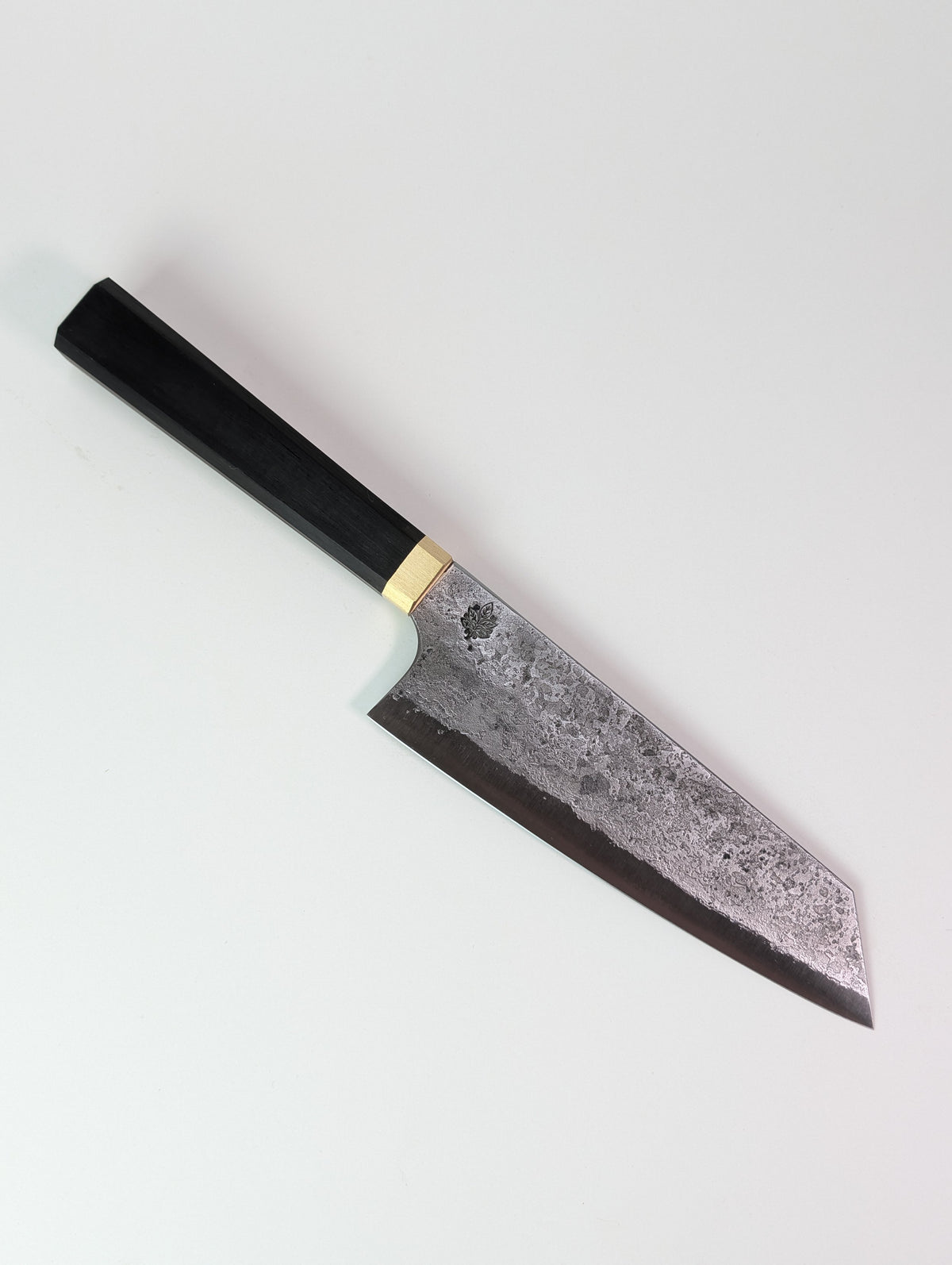
435 $ · Épuisé
Vendu par Atelier du Grand Frêne, Trois-Pistoles, Bas-Saint-Laurent · La boutique déclare adhérer à : Les Produits du Québec
Voir chez Atelier du Grand Frêne
This knife from the Grand Frêne collection is sold as shown, with a blade guard included.Specifications Use: Peeling vegetables, preparing fruit, cutting boneless meats and fish, and performing detailed cuts with the tip. Blade: 1095 carbon steel. Target blade length: 170 mm.
Blade height at the heel: 50 mm. Target spine thickness: 4 mm at the heel, 2.8 mm at mid-length, and 1.5 mm 10 mm from the tip. Grind: Convex.
Target hardness: 60 HRC. Handle: African blackwood. Handle length: 127 mm.
Ferrule: Brass. A versatile knife with a distinctive tip The Bunka is a Japanese knife whose name means "culture". This name accompanies a period of transformation in culinary habits in Japan, where Western influences are taking up more space.
By combining features of the Nakiri, intended for vegetables, and the Gyuto, inspired by the Western chef's knife, the Bunka meets the need to prepare several families of foods with a single blade. Close to the Santoku in its uses, it stands out today for its angular tip and its relatively straight edge. Its high blade is suitable for working vegetables on a board, while its fine tip allows to start an incision or perform detailed cuts.
This combination makes it a knife suitable for both everyday preparations and meticulous tasks. Our Bunka has a blade of approximately 170 mm, a format that maintains a good cutting length while remaining manageable. It is suitable for slicing vegetables, preparing fruit, slicing boneless meats, and cutting fish.
Its height offers room to guide the food with the fingers, while its tip facilitates work around a shallot or a small garnish. To use it comfortably, favor controlled downward and forward motions on a stable board. Let the edge pass through the food without excessive pressure and use the tip for details.
Avoid twisting movements in the food and do not use the tip as a lever. A blade designed for cutting efficiency The spine of the blade gradually thins from the heel to the tip. This geometry retains material near the handle while reducing the thickness toward the front of the knife.
It contributes to its balance and cutting efficiency. The convex grind helps the blade pass through the food. The heat treatment aims for a hardness of 60 HRC.
HRC is the scale used to measure the hardness of steel. This hardness contributes to the edge retention, provided the knife is used for the tasks it is intended for. Forged by hand, from raw material to edge Each knife from the Atelier du Grand Frêne starts with raw steel.
The blade is forged by hand to bring it to the desired proportions and thickness. This forge work already gives it most of its shape: there is relatively little material left to remove to obtain its profile. After forging, the blade is roughly shaped and its convex bevels are formed.
It then undergoes heat treatment. After quenching, it is ground and brushed, and the bevels are finish-ground. The African blackwood handle is shaped and fitted individually to each knife, with its brass ferrule.
Détails
- SKU
- AGFccjbunkas