Petty
335 $ · En stock
Vendu par Atelier du Grand Frêne, Trois-Pistoles, Bas-Saint-Laurent · La boutique déclare adhérer à : Les Produits du Québec
Voir chez Atelier du Grand Frêne
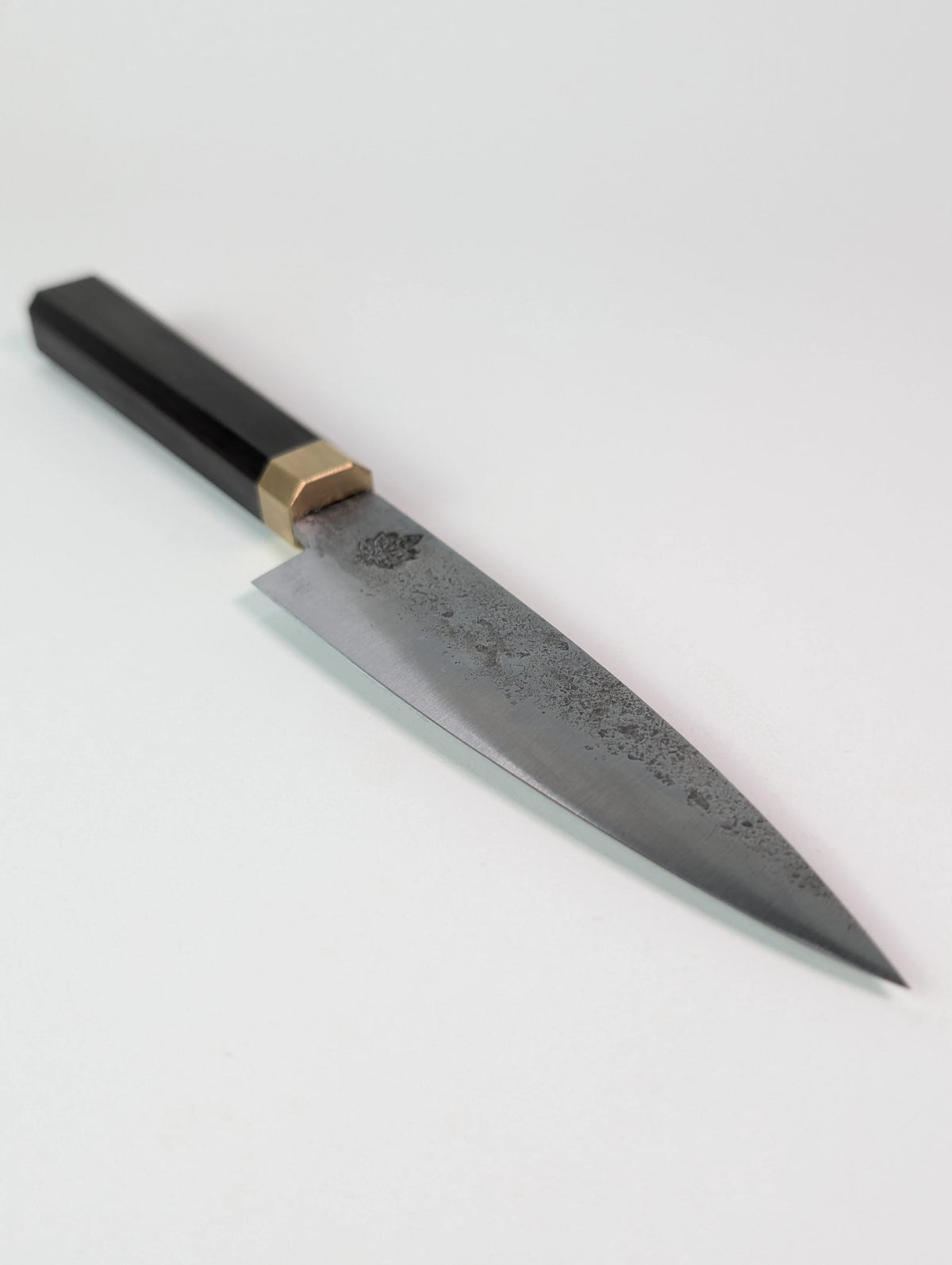
This knife from the Grand Frêne collection is sold as shown, with a blade guard included.Specifications Use: Peeling, trimming fruit and small vegetables, and trimming small pieces of meat. Blade: 1095 carbon steel. Target blade length: 120 mm.
Blade height at the heel: 28 mm. Target spine thickness: 2.8 mm at the heel, 2.5 mm at mid-length, and 1.2 mm 10 mm from the tip. Grind: Convex.
Target hardness: 60 HRC. Handle: African blackwood Handle length: 102 mm. Ferrule: Brass.
A small knife for precise tasks The Petty belongs to the family of Japanese knives with Western inspiration. Its name comes from the French word for "small," referring to its compact size. Its profile is reminiscent of a reduced Gyuto: a narrow blade that ends in a fine tip, suitable for meticulous cutting.
It performs tasks similar to those of a paring knife and a small utility knife, complementing a chef's knife. Our Petty has a 120 mm blade, a size that prioritizes maneuverability and control. It is suitable for peeling fruit, mincing shallots, trimming small vegetables, or trimming a small piece of boneless meat.
Its tip allows you to remove a damaged section, start an incision, or work precisely around a stem. Its short blade makes it easy to change direction and follow the contours of food. The Petty thus finds its place both in preparing ingredients and in finishing, when you need to adjust a cut or prepare a garnish.
It is ideal for tasks where a long blade would be cumbersome. On a stable cutting board, let the cutting edge advance into the food with short, controlled strokes, without excessive pressure. Use the center of the blade for common small cuts and the tip for details.
Avoid twisting the blade or prying with the tip to remove a pit or hard section. A blade designed for cutting efficiency The spine of the blade gradually thins from the heel to the tip. This geometry retains material near the handle while reducing the thickness toward the front of the knife.
It contributes to its balance and cutting efficiency. The convex grind helps the blade cut through food. The heat treatment aims for a hardness of 60 HRC.
HRC is the scale used to measure steel hardness. This hardness helps maintain the cutting edge, provided the knife is used for the tasks it is intended for. Forged by hand, from raw material to cutting edge Each knife from the Atelier du Grand Frêne begins as raw steel.
The blade is forged by hand to achieve the desired proportions and thickness. This forge work already gives it most of its shape: there is relatively little material left to remove to achieve its profile. After forging, the blade is roughly shaped and its convex bevels are formed.
It then undergoes heat treatment. After quenching, it is ground and brushed, and the bevels are finish-ground. The African blackwood handle is shaped and fitted individually to each knife, with its brass ferrule.
Détails
- SKU
- AGFccjpettys