Santoku
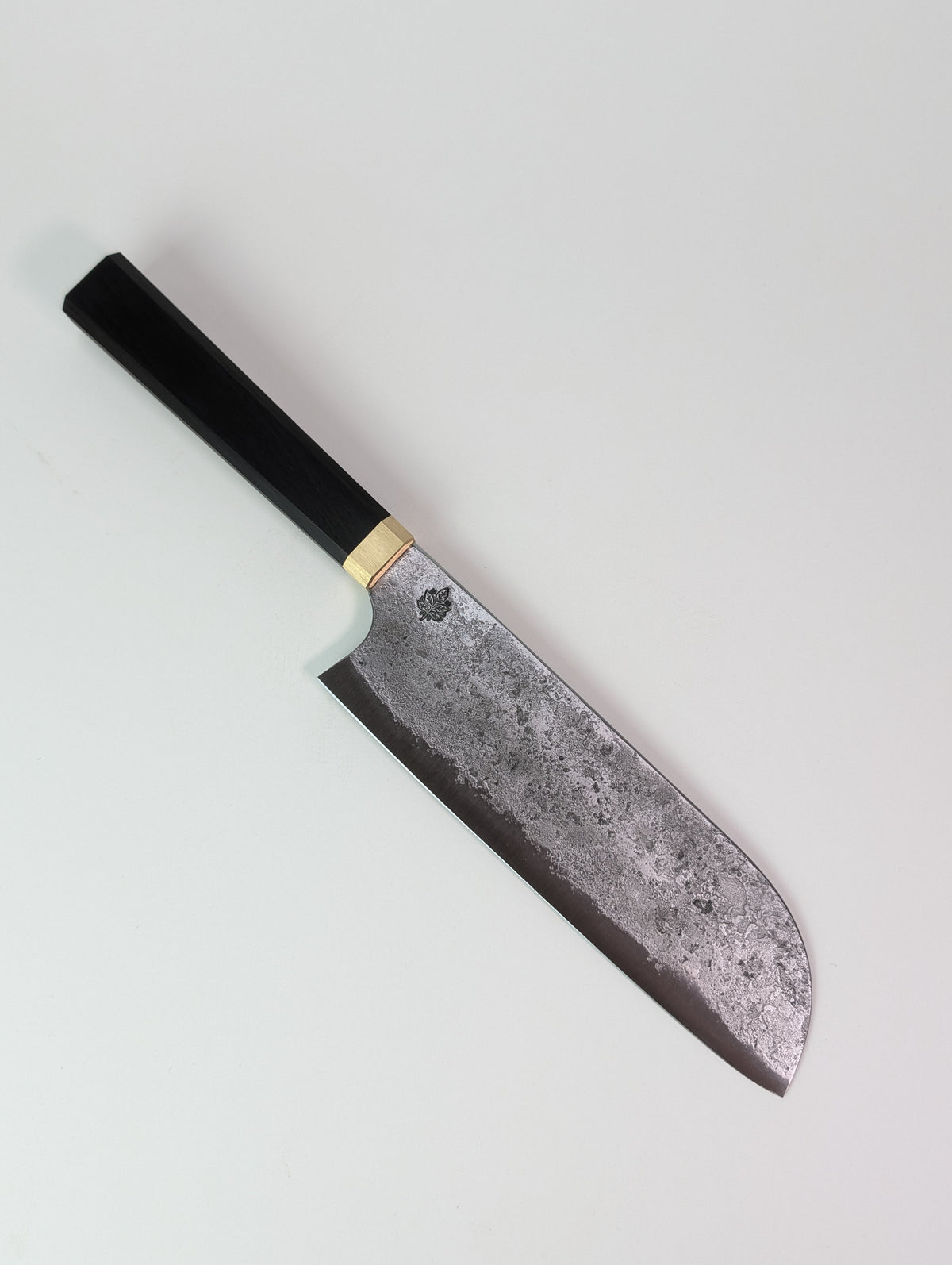
465 $ · En stock
Vendu par Atelier du Grand Frêne, Trois-Pistoles, Bas-Saint-Laurent · La boutique déclare adhérer à : Les Produits du Québec
Voir chez Atelier du Grand Frêne
This knife from the Grand Frêne collection is sold as shown, with a blade guard included.Specifications Use: Thinly slicing and trimming vegetables, slicing boneless meats, and preparing fish. Blade: 1095 carbon steel. Target blade length: 180 mm.
Blade height at the heel: 50 mm. Target spine thickness: 3.5 mm at the heel, 2.4 mm at mid-length, and 1.5 mm 10 mm from the tip. Grind: Convex.
Target hardness: 60 HRC. Handle: African blackwood. Handle length: 127 mm.
Ferrule: Brass. Three virtues for everyday cooking The Santoku is a versatile knife that has become common in Japanese kitchens. Its name means "three virtues," generally associated with the three families of foods it is designed to prepare: vegetables, meats, and fish.
Its development in the 20th century reflects changing eating habits in Japan and the need to combine several uses in a single knife. It thus combines features of Japanese knives designed for vegetables and fish with those of the Western chef's knife. Our Santoku has a 180 mm blade, a size that offers a good cutting length while remaining manageable on a cutting board.
It is suitable for thinly slicing vegetables, trimming fruit, slicing boneless meats, and preparing fish. This versatility makes it a primary knife for many everyday food preparation tasks. Its high blade provides ample room to guide food with your fingers.
Its relatively straight cutting edge facilitates controlled cuts downward and forward. Similar to the Bunka in its uses, the Santoku has a more rounded profile toward the tip, which retains its usefulness for starting an incision or making a small cut. To use it comfortably, work on a stable cutting board and let the cutting edge pass through the food without excessive pressure.
Use the center of the blade for common cuts and adjust the range of your motion to the size of the ingredients. Avoid twisting the blade in the food or using the tip as a lever. A blade designed for cutting efficiency The spine of the blade gradually tapers from the heel to the tip.
This geometry retains material near the handle while reducing the thickness toward the front of the knife. It contributes to its balance and cutting efficiency. The convex grind helps the blade pass through food.
The heat treatment aims for a hardness of 60 HRC. HRC is the scale used to measure the hardness of steel. This hardness helps maintain the cutting edge, provided the knife is used for the tasks it is designed for.
Forged by hand, from raw material to cutting edge Every knife from the Atelier du Grand Frêne begins as raw steel. The blade is forged by hand to achieve the desired proportions and thickness. This forging process already gives it most of its shape: very little material remains to be removed to achieve its profile.
After forging, the blade is roughly shaped and its convex bevels are formed. It then undergoes heat treatment. After quenching, it is ground and brushed, and the bevels are finish-ground.
Détails
- SKU
- AGFccjsantokus