Sujihiki
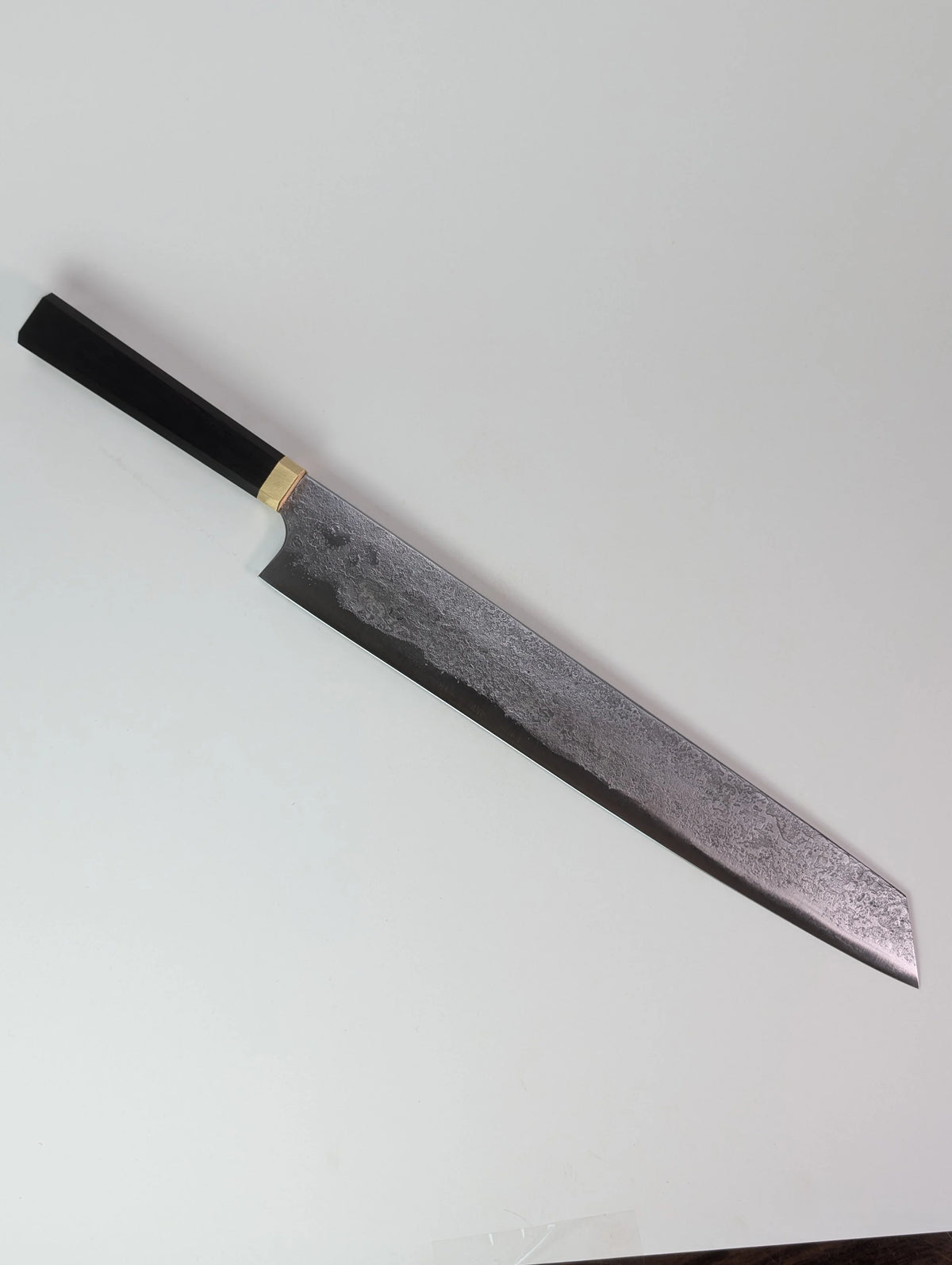
685 $ · En stock
Vendu par Atelier du Grand Frêne, Trois-Pistoles, Bas-Saint-Laurent · La boutique déclare adhérer à : Les Produits du Québec
Voir chez Atelier du Grand Frêne
This knife from the Grand Frêne collection is sold as shown, with a blade guard included.Specifications Use: Slicing roasts and boneless meats, cutting fish, and making thin, long, uniform slices. Blade: 1095 carbon steel. Target blade length: Approximately 310 mm.
Blade height at the heel: 45 mm. Target spine thickness: 4 mm at the heel, 2.8 mm at mid-length, and 1.5 mm 10 mm from the tip. Grind: Convex.
Target hardness: 60 HRC. Handle: African blackwood. Handle length: 127 mm.
Ferrule: Brass. A long blade for clean slices The Sujihiki is the Japanese adaptation of the Western slicing knife. Its name refers to the cutting of meat and tendons, related to its use for preparing and trimming cuts of meat.
Its long and narrow silhouette is designed for a pulling cut, in which the cutting edge gradually passes through the food. Today, it is equally suited to slicing meat and preparing fish. Our Sujihiki has a blade measuring approximately 310 mm, a length that allows it to pass through a roast, a piece of boneless meat, or a fish fillet in one broad, continuous motion.
It is also suitable for preparations that require thin, uniform slices, such as carpaccio, ham, or salmon slices. Its narrow blade reduces the surface area in contact with the food and makes it easier to pass the knife through during cutting. Its length helps reduce repetitive motions, which helps achieve a uniform cutting surface.
The Sujihiki is thus ideal for tasks where continuity of motion is as important as the precision of the cut. To take advantage of its length, use a stable and sufficiently large cutting board. Begin the cut with the cutting edge near the heel, then gradually pull the blade toward you using its length.
Let the knife do the work without excessive pressure and try to make the slice in a single pass when the food allows. Avoid twisting the blade and cutting bones or frozen food. A blade designed for cutting efficiency The spine of the blade gradually tapers from the heel to the tip.
This geometry retains material near the handle while reducing the thickness toward the front of the knife. It contributes to its balance and cutting efficiency. The convex grind helps the blade pass through food.
The heat treatment aims for a hardness of 60 HRC. HRC is the scale used to measure the hardness of steel. This hardness helps maintain the cutting edge, provided the knife is used for the tasks it is intended for.
Forged by hand, from raw material to cutting edge Every knife from the Atelier du Grand Frêne begins as raw steel. The blade is forged by hand to achieve the desired proportions and thickness. This forging work already gives it most of its shape: there is relatively little material left to remove to achieve its profile.
After forging, the blade is roughly shaped and its convex bevels are formed. It then undergoes heat treatment. After quenching, it is ground and brushed, and the bevels are finish-ground.
Détails
- SKU
- AGFccjsujihikis